1526–1555

Humanist · Scholar · Translator

Olympia Fulvia Morata

Resumo
An Italian humanist from Ferrara, one of the most remarkable scholars of the Renaissance. She embraced the Reformed faith at the court of Renée of France, translated Psalms into Homeric Greek, and defended, with her own life, women's right to serious study of the Scriptures and the classics.
Quem foi
Biografia

At twelve, Olympia Fulvia Morata was already reading and debating, in Greek and Latin, classics that most men of her time never touched. Born in Ferrara, daughter of the humanist Fulvio Pellegrino Morato, she was educated at home with a rigor rare for a girl of the Renaissance.

In 1539 she entered the court of Ferrara as study companion to Anna d’Este, under the patronage of Renée of France, whose sympathies leaned toward the Reformed faith. There she mingled with Reformed thinkers, among them John Calvin, and deepened her engagement with the Bible.

After her father’s death in 1548, she lost favor at court: the atmosphere turned hostile to heterodoxy, and she went so far as to write that, for as long as she remained there, she was never able to read the books of the Old or New Testament freely. The praise she had received in childhood from scholars such as Celio Calcagnini, a friend of her father, brought no serious recognition once she became an adult: in a letter to a former teacher, she complained of being abandoned by the court and treated in a humiliating way.

Around 1549 and 1550 she married Andreas Grunthler, a Bavarian physician and scholar, in a Protestant ceremony. The union also sealed a choice of faith: shortly afterward the couple left Italy and settled in Germany.

In Schweinfurt, Olympia devoted herself to theology and translated seven Psalms into Homeric Greek, joining classical form to biblical content. In letters and dialogues she also argued that serious study should not be denied to women.

In 1553 and 1554, during the Second Margrave War, Schweinfurt was besieged and sacked. Olympia fled barefoot, lost her library and most of her writings, and was even imprisoned with her husband in Hammelburg under threat of death, until they were protected by the Count and Countess of Erbach.

Taking refuge in Heidelberg, she rebuilt part of her library from memory and began teaching Greek and Latin privately. Her health, already weakened by the flight, began to fail.

She died in Heidelberg on October 26, 1555, likely of tuberculosis. Her husband and her friend Celio Secondo Curione gathered her letters and writings, published in Basel in 1558, a text that centuries later would be read again, including by Goethe.
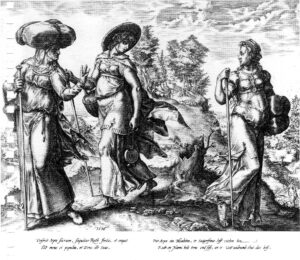
“I, though born a woman, left behind womanly things: the wool, the shuttle, the threads of the loom, and the work baskets.”
Olympia Fulvia Morata · Greek poem (16th century), in "The Complete Writings of an Italian Heretic," trans. Holt N. Parker, University of Chicago Press, 2003
Linha do tempo
1526

Birth in Ferrara

Daughter of the humanist Fulvio Pellegrino Morato, she was educated in Latin and Greek from an early age.

1539

Entry into the court of Ferrara

Becomes study companion to Anna d'Este under the patronage of Renée of France.

1540-1548

Advanced education and Reformed contacts

Deepens her study of rhetoric, the Bible, and the classics; associates with Protestant thinkers, among them John Calvin.

1548

Death of her father and fall from favor

Loses the court's support and is prevented from freely reading the Scriptures.

1549-1550

Marriage to Andreas Grunthler

Marries the Bavarian physician in a Protestant ceremony and leaves Italy.

1552-1553

Translation of the Psalms in Schweinfurt

Renders seven Psalms into Homeric Greek while devoting herself to theology.

1553-1554

Siege and sack of Schweinfurt

Flees barefoot, loses her library and writings, and is imprisoned with her husband under threat of death.

1554

Settling in Heidelberg

Rebuilds part of her library from memory and begins teaching Latin and Greek.

1555

Death in Heidelberg

Dies on October 26, likely of tuberculosis contracted during her flight.

Obras e marcos

Defense of Cicero

around 1540

A public debate on Cicero's work at the court of Ferrara, now lost, that revealed her rhetorical precocity.

Commentary on the Paradoxa Stoicorum

1542

A study of Cicero's Stoic work, written while she was still a teenager.

Latin translation of tales from the Decameron

1544-1545

Rendered two of Boccaccio's tales into Latin, removing Catholic references from the original text.

Dialogue of Theophila and Philotima

1551

A treatise on spirituality and study, written for a friend at court, Lavinia della Rovere.

Translation of the Psalms into Homeric Greek

1552-1553

Seven Psalms rendered into classical Greek in Schweinfurt, later set to music by her husband.

Collected letters and writings

Basel, 1558

Letters, poems, and dialogues compiled by her husband and Celio Secondo Curione and published after her death.

Contribuições
1

Female scholarship in Latin and Greek

She was one of the few women in sixteenth century Europe to write in classical Latin and Greek rather than only in the vernacular, which made her a point of reference for serious study for later generations.

2

Advocacy for women's education

In letters and dialogues, she argued that access to the Scriptures and the classics should not be denied to women, going against the custom of her time.

3

Poetic translation of the Psalms

She rendered seven Psalms into Homeric Greek, uniting the form of classical poetry with biblical content, a rare exercise in Christian humanism.

4

Testimony of faith under persecution

She left Italy, her family, and the comfort of the court out of Protestant conviction, and faced imprisonment and threat of death without renouncing her faith.

Legado missionário

She is remembered as a pioneer among women who united serious scholarship with Protestant faith, inspiring Christian translators and educators.

Her flight and imprisonment for the sake of her faith speak to persecuted Christians today who leave land and comfort out of conviction.

Her example of rigorous biblical study underscores the importance of theological training for women in churches and on the mission field.

Her translation of the Psalms is a reminder of the value of putting scholarship and artistic talent at the service of the Word.

Outras pessoas